
Fundamental principles for study
16All scripture is given by inspiration of God, and is profitable for doctrine, for reproof, for correction, for instruction in righteousness: 17that the man of God may be perfect, throughly furnished unto all good works.
(2 Timothy 3:16–17)
For me, this passage serves as the basis for reading and understanding the text of the Bible. The whole of Scripture—namely the 66 books, comprising both the Old and New Testaments— constitutes for me, a single coherent whole. This does not mean that there cannot be differences in emphasis; I will come back to this later in this article, but deliberately disregarding parts of the Bible is not the correct approach.
The passage quoted provides us with four key aspects that are useful for dealing with the text correctly:
1. Doctrine
This means explaining how something works. This relates not only to the story as it is told to us and the facts presented, but also to the connection between all these different aspects.
2. Reproof
This involves exposing the lies that are presented to us; we must test what is supposedly offered to us as truth against the Bible.
3. Correction
This is a way of looking at ourselves in the mirror and comparing ourselves with the standard set out in the Bible, so that we can make the necessary adjustments.
4. Instruction
This relates to our growth towards maturity. Every form of life is characterised by growth; where growth stagnates, life dies a slow death.
19We have also a more sure word of prophecy; whereunto ye do well that ye take heed, as unto a light that shineth in a dark place, until the day dawn, and the day star arise in your hearts: 20knowing this first, that no prophecy of the scripture is of any private interpretation. 21For the prophecy came not in old time by the will of man: but holy men of God spake as they were moved by the Holy Ghost.
(2 Peter 1:19–21)
Scripture is given by God; God inspired people with authority to put matters into words. It is therefore of the utmost importance that we treat the text with respect as such. It is important to understand that every word is to be valued appropriately. If, on the other hand, we lose that sacred respect, we may end up projecting our own ideas – such as desires and tradition – onto the text, thereby, so to speak, making the text say something that is not meant.
Old versus New
How should I weigh up the biblical text, and what should be the guiding principle? I often come across the claim that, in the time of the apostles, the Bible consisted solely of the Old Testament, and that this should therefore be the guiding principle. The question I have long wrestled with is whether this is actually true. Over the years, I have come to the conclusion that the New Testament explains the Old and must therefore be regarded as the guiding principle
28For I say unto you, Among those that are born of women there is not a greater prophet than John the Baptist: but he that is least in the kingdom of God is greater than he.
(Luke 7:28)
This refers to John the Baptist, whom Jesus identifies as the greatest prophet of all; one might even say that he is greater than Moses and Elijah. It is clear that the period in which John ministered was a very special one, and I believe that is what makes him the greatest. What is important here is that we see that even this greatest of all prophets cannot compare with even the least in the Kingdom; John was permitted to announce the coming of the Kingdom but was not himself part of it. Jesus himself, as well as his apostles, are part of the Kingdom and can therefore speak with far greater authority than the prophets.
29The secret things belong unto the LORD our God: but those things which are revealed belong unto us and to our children for ever, that we may do all the words of this law. (Deuteronomy 29:29)
Towards the end of his life, Moses indicated that, alongside the revealed Law, there were also matters that had been kept hidden which were not yet relevant to the people of Israel at that time; for the time being, the Law was sufficient for them. It therefore seems to me an exaggeration to think that the Law provided everything. In many circles today, it is believed that the Law should be regarded as the foundation, upon which the rest of the Bible builds, and that the New Testament is merely a minor addition which, strictly speaking, would not even be necessary; to hold this view is to do injustice to Moses’ statement. In the New Testament, it is Paul in particular who teaches matters that had remained unknown until the coming of Jesus and were only revealed thereafter.
25Now to him that is of power to stablish you according to my gospel, and the preaching of Jesus Christ, according to the revelation of the mystery, which was kept secret since the world began, 26but now is made manifest, and by the scriptures of the prophets, according to the commandment of the everlasting God, made known to all nations for the obedience of faith
(Romans 16:25–26)
In this passage, Paul indicates that, in the proclamation of the Gospel, matters have been revealed that were previously unknown. Paul uses the word ‘mystery’ for this; indeed, this word recurs in various places throughout his teaching. Here are a few examples:
7but we speak the wisdom of God in a mystery, even the hidden wisdom, which God ordained before the world unto our glory.
(1 Corinthians 2:7)
26even the mystery which hath been hid from ages and from generations, but now is made manifest to his saints
(Colossians 1:26)
To assume, on the basis of this, that the Old Testament essentially contains everything one needs is therefore incorrect. The fact that not everything has yet been revealed in the first instance also has a strategic reason.
8which none of the princes of this world knew: for had they known it, they would not have crucified the Lord of glory.
(1 Corinthians 2:8)
Matters were evidently not only hidden from the people of Israel, but were also apparently unknown in the spiritual world. By crucifying Jesus, the devil shot himself as it were in the foot; Jesus’ death on the cross meant his downfall.
Shadow
Paul uses the term ‘shadow’ to indicate that there is a great difference between what was revealed in the Old Testament and what has been given to us in the New Testament
16Let no man therefore judge you in meat, or in drink, or in respect of an holyday, or of the new moon, or of the sabbath days: 17which are a shadow of things to come; but the body is of Christ
(Colossians 2:16-17)
All the matters mentioned by Paul relate to the Law and the ceremonies surrounding the temple service, which he compares to a shadow; I have attached a few images for reference.
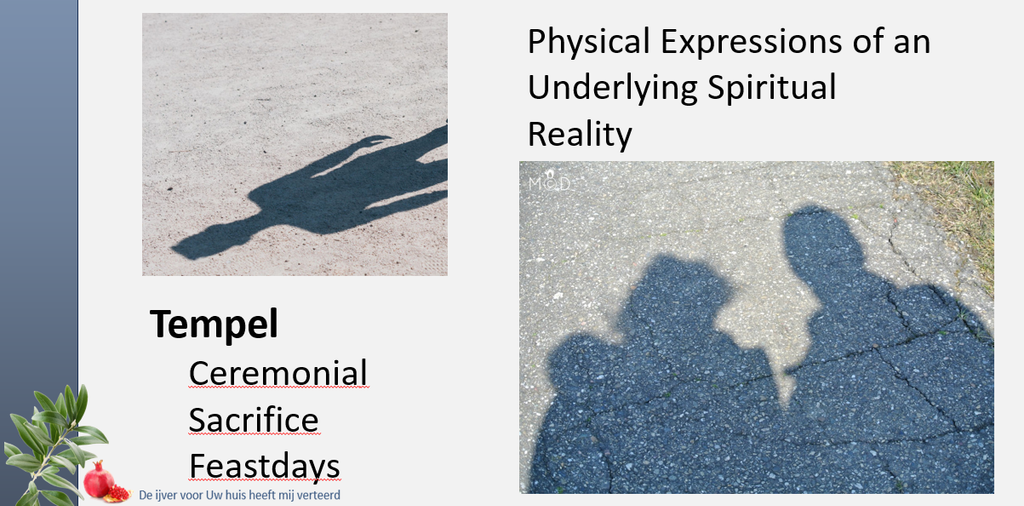
As can be seen in the image, a shadow is nothing more than a sort of silhouette; whilst you can deduce certain things from it, it does no more than leave an impression. By using the word ‘shadow’, Paul indicates that the reality we have come to share in through Christ is far greater. The Law and the temple service do give us a glimpse of what it will be like in the future, but the reality itself only becomes clear with the coming of Christ. Here are a few more passages from the Epistle to the Hebrews where Paul also discusses this same phenomenon:
5who serve unto the example and shadow of heavenly things, as Moses was admonished of God when he was about to make the tabernacle: for, See, saith he, that thou make all things according to the pattern shewed to thee in the mount.
(Hebrews 8:5)
1For the law having a shadow of good things to come, and not the very image of the things, can never with those sacrifices which they offered year by year continually make the comers thereunto perfect.
(Hebrews 10:1)
The reality of which Paul speaks is spiritual or heavenly; within our earthly reality, this cannot be fully conveyed. The people of Israel in the Old Testament had to rely on a picture that gave them a glimpse of what was to come, but the rest could only become visible with the coming of Jesus, who is the One bringing the heavenly Kingdom in which He Himself is the tabernacle or temple.
Jesus
After His resurrection, it is Jesus Himself who begins to explain matters which, although recorded in the Bible, had not yet been fully understood as such. The first instance is the encounter that two of His disciples had with Him on their journey to Emmaus
25Then he said unto them, O fools, and slow of heart to believe all that the prophets have spoken: 26ought not Christ to have suffered these things, and to enter into his glory? 27And beginning at Moses and all the prophets, he expounded unto them in all the scriptures the things concerning himself.
(Luke 24:25–27)
Jesus personally explains to them the Scriptures that refer to Him. A little later, just before He ascends to heaven, He has a final meeting with the whole group of disciples.
44And he said unto them, These are the words which I spake unto you, while I was yet with you, that all things must be fulfilled, which were written in the law of Moses, and in the prophets, and in the psalms, concerning me. 45Then opened he their understanding, that they might understand the scriptures, 46and said unto them, Thus it is written, and thus it behoved Christ to suffer, and to rise from the dead the third day: 47and that repentance and remission of sins should be preached in his name among all nations, beginning at Jerusalem.
(Luke 24:44–47)
This group of people had been with Jesus throughout His public ministry, yet they too needed Him to open their understanding so that they might understand the Scriptures.
Revelation of the Spirit
12I have yet many things to say unto you, but ye cannot bear them now. 13Howbeit when he, the Spirit of truth, is come, he will guide you into all truth: for he shall not speak of himself; but whatsoever he shall hear, that shall he speak: and he will shew you things to come. 14He shall glorify me: for he shall receive of mine, and shall shew it unto you. 15All things that the Father hath are mine: therefore said I, that he shall take of mine, and shall shew it unto you.
(John 16:12–15)
In this final section of teaching, which the disciples receive before Jesus sets out on the path to the cross, Jesus indicates that in order to understand things properly, they need the Spirit of Truth; this also means for us that, without the revelation of the Spirit, the Bible remains a closed book—and this applies equally to the people of Israel when reading the Old Testament.
14but their minds were blinded: for until this day remaineth the same vail untaken away in the reading of the old testament; which vail is done away in Christ. 15But even unto this day, when Moses is read, the vail is upon their heart. 16Nevertheless when it shall turn to the Lord, the vail shall be taken away.
17Now the Lord is that Spirit: and where the Spirit of the Lord is, there is liberty. 18But we all, with open face beholding as in a glass the glory of the Lord, are changed into the same image from glory to glory, even as by the Spirit of the Lord.
(2 Corinthians 3:14–18)
The majority of the Jews at that time did not accept Jesus; as a result, a veil has been cast over the Law and the Prophets. Only when they repent of their rejection of Jesus will the Scriptures be opened to them once again. This, of course, applies not only to them but also to us; if we do not truly submit to the lordship of Jesus, a veil will also be cast over the Bible for us; we must receive Jesus with an open heart.
The how and what
160The sum of Your word is truth…
(Psalm 119:160a NASB)
To understand the Bible properly, we must read it in its entirety; we cannot get by with just one or two passages or a small section.
TEXT – CONTEXT – CO-TEXT = PRETEXT
We can make a little play on words: if we read and interpret the text without considering the context and the co-text, a ‘pretext’ arises – a sort of excuse that allows us to sidestep the text.
Context: textual surroundings
‐ Verse or sentence context
‐ Chapter
‐ Entire book or letter
‐ Entire testament
‐ The Bible as a whole
‐ Time and circumstances
Co-text: other texts and passages dealing with the same subject
Pretext: excuse or pretence
It is very important to understand that the text must be read and interpreted in harmony with the context and must be consistent with other passages dealing with the same subject.
Type of text
In the Bible, we encounter various kinds or types of text which must be distinguished from one another to prevent us from straying from the right path when interpreting the Bible:
Prose, or descriptive text.
‐ This text should be read literally.
Metaphorical, or comparative.
‐ This text is intended to clarify something by means of a comparison
Apocalyptic, or figurative.
– The text paints a picture that allows us to form an impression.
‐ Depicting spiritual reality in physical terms or images.
It is very important that we do distinguish between these different types of text to prevent us from misunderstanding things. A large part of the text is simply descriptive and should simply be read as it stands. In the Gospels, Jesus uses parables; if you take these too literally, you run the risk of reading things into the text that were not intended. Incidentally, you will also come across parables in other parts of the Bible. Finally, I would like to point out that the Bible makes use of a kind of imagery to clarify certain points. In particular, the prophecies of Ezekiel and Daniel in the Old Testament – and, of course, the bulk of the Book of Revelation – employ this style. Because spiritual reality cannot be perceived by us through our senses, this style gives us an impression of spiritual reality through physical imagery. It should be clear that a literal interpretation would lead us astray.
In conclusion
Finally, here is a passage that was somewhat of an eye-opener to me:
1The first account I composed, Theophilus, about all that Jesus began to do and teach, 2until the day when He was taken up to heaven…
(Acts 1:1-2a)
Within Jewish tradition, it is pointed out that the Torah is said to consist of 613 laws. This approach carries the risk that we see the rules but not God’s historical words and deeds. The Bible therefore describes three things to us:
· Who God or Jesus is
· What He has done
· What He has said
All three aspects are important and must be in harmony with one another.
With this account, I have sought to clarify how I believe we should approach the text of the Bible; you will therefore find this perspective reflected on this website and in other publications I have authored.
